


年三日坊主のKKです。
前回ご紹介した毎年恒例のココイチ創業祭ですが、今年は37杯グランド・マザー・カレーを食べスプーンを7本当てました。
ただ、4種類のスプーンのうち、オメガ4本、セブン2本、ティガ1本と3種類までしか集められず、4種類コンプリートは叶いませんでした。
「オメガかセブンとウルトラマンを交換しても良いよ」という方がいらっしゃいましたら、ご連絡頂けますと幸いです。
※この記事は執筆時点(2026年3月3日)の情報を元に記載しています。事態の進展により状況が変化する点にご留意ください。
さて、2月28日からアメリカ・イスラエルがイランを攻撃し、それに対してイランが中東諸国に報復攻撃するという事態が発生しています。
これまでも「サイバースペースの地政学」に関する記事などで戦争や災害とITについて取り上げてきましたが、今回の中東での戦争では実際にAWSのデータセンターが被害に遭った模様です。
-
「サイバースペースの地政学」雑感1:電話局のビルって良いよね
-
「サイバースペースの地政学」雑感2:データをどう運ぶ?
-
「サイバースペースの地政学」雑感3:電話局の鉄塔のパラボラアンテナを懐かしむ
-
さくらインターネット様「SAKURA Partner Meetup in 北海道 2025」に参加してきました1
2026/03/01 21:51(JST):ME-CENTRAL-1で「エラー率の増加」
3月1日の日本時間21:51、「AWS Health Dashboard」に見慣れたメッセージが掲載されました。
- タイトル:Service impact: Increased Error Rates(サービスへの影響:エラー率の増加)
- 本文:We are investigating issues with AWS services in the ME-CENTRAL-1 Region.
訳文:私たちはME-CENTRAL-1リージョンにおけるAWSサービスの問題を調査しています。
見慣れないリージョンですが良くあるタイトルです。
ME-CENTRAL-1リージョンはアラブ首長国連邦(UAE)のドバイにあるとされる中東中央リージョンです。
この時点ではこれが戦争の影響とは思いもよりませんでした。
2026/03/01 22:19(JST):第二報
続いて掲載された第二報も同じタイトルですが、対象のアベイビリティゾーンが特定され原因が局所的な電力問題とされています。
- タイトル:Service impact: Increased Error Rates(サービスへの影響:エラー率の増加)
- 本文:We are investigating connectivity and power issues affecting APIs and instances in a single Availability Zone (mec1-az2) in the ME-CENTRAL-1 Region due to a localized power issue. Existing instances in this zone will also be affected. Other AWS Services may also be experiencing increased errors and latencies for their workflows, and we are working to route requests away from this affected Availability Zone. We recommend customers make use of other Availability Zones at this time. Targeting new launches using RunInstances in the remaining AZs should succeed. Existing instances in the other AZs are not affected.
訳文:私たちは、ME-CENTRAL-1リージョンの単一のアベイビリティゾーン(mec1-az2)におけるAPIおよびインスタンスに影響を与える接続性と電力の問題を調査しています。これは局所的な電力問題によるものです。このゾーン内の既存のインスタンスも影響を受けます。他のAWSサービスもワークフローでエラーや遅延の増加を経験している可能性があり、私たちはこの対象の可用性ゾーンからリクエストをルーティングする作業を進めています。現時点では他のアベイラビリティゾーンを利用することをお勧めします。残りのAZでRunInstancesを使って新規ローンチをターゲットにすれば成功するはずです。他のAZの既存のインスタンスは影響を受けません。
データセンターの障害で電力が問題となるのはよくあることなので、この後も原因については同様で影響範囲や対応状況のアップデートが第三報以降も続いていても、よくある故障と思っていました。
2026/03/02 02:41(JST):第六報
日本時間では日付が変わって3月2日に公開された第六報で驚きの事実が判明しました。
- タイトル:Service impact: Increased Error Rates(サービスへの影響:エラー率の増加)
- 本文:We want to provide some additional information on the power issue in a single Availability Zone in the ME-CENTRAL-1 Region. At around 4:30 AM PST, one of our Availability Zones (mec1-az2) was impacted by objects that struck the data center, creating sparks and fire. The fire department shut off power to the facility and generators as they worked to put out the fire. We are still awaiting permission to turn the power back on, and once we have, we will ensure we restore power and connectivity safely. (略)
訳文:ME-CENTRAL-1リージョンの単一のアベイラビリティゾーンにおける電力問題について、さらに情報を提供したいと思います。午前4時30分頃(PST)、当社のアベイビリティゾーンの一つ(mec1-az2)が、データセンターに衝突した物体の影響を受け、火花と火災が発生しました。消防署は火災消火作業のため、施設と発電機の電源を遮断しました。まだ電力復旧の許可を待っており、許可が下り次第、安全に電力と接続を回復できるようにします。(略)
午前4時30分頃(PST)すなわち初報の20分前、日本時間21:30頃に件のアベイビリティゾーンを構成するデータセンターに衝突した物体による影響を受け、火災が発生していたとのこと。
つまりドローンなのかミサイルなのかはわかりませんが「物体(objects)」による攻撃を受けた影響で火災が起き、電源が遮断されたということで、ここで報道されていたイランの報復攻撃の影響と理解しました。
取り急ぎ、弊社のお客様で影響が出ていないか確認するとともに、戦争の影響が出ていることを関係者に周知しました。
2026/03/02 14:56(JST):ME-SOUTH-1で「接続問題とAPIエラー率の増加」
ME-CENTRAL-1リージョンの障害が復旧していない状況で半日後、中東の別のリージョンから障害通知がありました。
- タイトル:Service impact: Increased connectivity issues and API Error Rates(サービスへの影響:接続問題の増加とAPIエラー率)
- 本文:We are investigating increased API error rates in a single Availability Zone (mes1-az2) in the ME-SOUTH-1 Region.
訳文:ME-SOUTH-1リージョン内の単一のアベイビリティゾーン(mes1-az2)におけるAPIエラー率の増加を調査しています。
ME-SOUTH-1リージョンはバーレーンにあるとされる中東リージョンです。
報道ではバーレーンに対してもイランの報復攻撃があったようで嫌な予感がします。
この後、ME-SOUTH-1リージョンに関する障害通知第七報まではおなじみの電源問題という表現でした。
2026/03/03 09:22(JST):AWSが明確にドローン攻撃を受けたことを発表
障害が発生している2つの中東リージョンについて、AWSは明確にドローン攻撃の影響であり、被害を受けたデータセンターの早期復旧が難しいことを発表しました。
少し長いですが、この発表内容は全文を引用します。
- タイトル:Service impact: Increased connectivity issues and API Error Rates(サービスへの影響:接続問題の増加とAPIエラー率)
- 本文:We are providing an update on the ongoing service disruptions affecting the AWS Middle East (UAE) Region (ME-CENTRAL-1) and the AWS Middle East (Bahrain) Region (ME-SOUTH-1). Due to the ongoing conflict in the Middle East, both affected regions have experienced physical impacts to infrastructure as a result of drone strikes. In the UAE, two of our facilities were directly struck, while in Bahrain, a drone strike in close proximity to one of our facilities caused physical impacts to our infrastructure. These strikes have caused structural damage, disrupted power delivery to our infrastructure, and in some cases required fire suppression activities that resulted in additional water damage. We are working closely with local authorities and prioritizing the safety of our personnel throughout our recovery efforts.
In the ME-CENTRAL-1 (UAE) Region, two of our three Availability Zones (mec1-az2 and mec1-az3) remain significantly impaired. The third Availability Zone (mec1-az1) continues to operate normally, though some services have experienced indirect impact due to dependencies on the affected zones. In the ME-SOUTH-1 (Bahrain) Region, one facility has been impacted. Across both regions, customers are experiencing elevated error rates and degraded availability for services including Amazon EC2, Amazon S3, Amazon DynamoDB, AWS Lambda, Amazon Kinesis, Amazon CloudWatch, Amazon RDS, and the AWS Management Console and CLI. We are working to restore full service availability as quickly as possible, though we expect recovery to be prolonged given the nature of the physical damage involved.
In parallel with efforts to restore the physical infrastructure at the affected sites, we are pursuing multiple software-based recovery paths that do not depend on the underlying facilities being fully brought back online. For Amazon S3 and Amazon DynamoDB, we are actively working to restore data access and service availability through software mitigations, including deploying updates to enable S3 to operate within the current infrastructure constraints and remediating impaired DynamoDB tables to restore read and write availability for dependent services. Our focus on restoring these foundational services is deliberate, as recovery of Amazon S3 and Amazon DynamoDB will in turn enable a broad range of dependent AWS services to recover. For other affected service APIs, we are deploying targeted software updates to reduce error rates and restore functionality where possible, independent of the physical recovery timeline. We are also working to restore access to the AWS Management Console and CLI through network-level changes that route traffic away from the affected infrastructure. While these software-based mitigations can address many of the service-level impacts, some recovery actions are constrained by the physical state of the affected facilities — meaning that full restoration of certain services will require the underlying infrastructure to be repaired and brought back online. Across all services, our teams are working in parallel on both the physical restoration of the affected facilities and these software-based mitigations, with the goal of restoring as much customer access as possible as quickly as possible, even ahead of full infrastructure recovery. In addition, we are prioritizing the restoration of services and tools that enable customers to back up and migrate their data and applications out of the affected regions.
Finally, even as we work to restore these facilities, the ongoing conflict in the region means that the broader operating environment in the Middle East remains unpredictable. We recommend that customers with workloads running in the Middle East consider taking action now to backup data and potentially migrate your workloads to alternate AWS Regions. We recommend customers exercise their disaster recovery plans, recover from remote backups stored in other regions, and update their applications to direct traffic away from the affected regions. For customers requiring guidance on alternate regions, we recommend considering AWS Regions in the United States, Europe, or Asia Pacific, as appropriate for your latency and data residency requirements.
We will continue to provide updates as recovery progresses and as the situation evolves. Our next update will be provided by 9:00 PM PST on March 2, 2026, or sooner if new information becomes available.
訳文:AWS中東(UAE)リージョン(ME-CENTRAL-1)およびAWS中東(バーレーン)リージョン(ME-SOUTH-1)に影響を及ぼす現在のサービス障害についての最新情報を提供しています。中東での紛争が続くため、両リージョンともドローン攻撃によるインフラの物理的な影響を受けています。UAEでは2つの施設が直接攻撃を受け、バーレーンでは施設の近くでドローン攻撃がインフラに物理的な影響を与えました。これらの攻撃は構造的な損傷を引き起こし、インフラへの電力供給を妨げ、場合によっては火災抑制活動を余儀なくされ、さらに水害が発生しました。私たちは地元当局と緊密に連携し、復旧活動を通じて職員の安全を最優先にしています。
ME-CENTRAL-1(UAE)リージョンでは、3つのアベイビリティゾーンのうち2つ(mec1-az2とmec1-az3)が著しく機能障害を抱えています。第3のアベイビリティゾーン(mec1-az1)は通常通り運用されていますが、影響を受けるゾーンへの依存により一部のサービスが間接的な影響を受けています。ME-SOUTH-1(バーレーン)リージョンでは、1つの施設が影響を受けました。両リージョンで、Amazon EC2、Amazon S3、Amazon DynamoDB、AWS Lambda、Amazon Kinesis、Amazon CloudWatch、Amazon RDS、AWS Management ConsoleおよびCLIなどのサービスでエラー率の上昇と可用性の低下が顧客に見られています。できるだけ早くフルサービスの復旧を目指していますが、物理的な損傷の性質から回復には時間がかかると予想しています。
影響を受けたサイトの物理的インフラの復旧と並行して、基盤となる施設の完全復旧に依存しない複数のソフトウェアベースの復旧経路を追求しています。Amazon S3およびAmazon DynamoDBについては、ソフトウェアの緩和策を通じてデータアクセスとサービスの可用性を回復するために積極的に取り組んでいます。現在のインフラ制約内でS3が動作できるようにアップデートを展開したり、依存サービスに対して読み書きの可用性を回復するために障害を受けたDynamoDBテーブルの修復を行ったりしています。これらの基礎サービスを復旧することに注力することは意図的であり、Amazon S3とAmazon DynamoDBの復旧は、幅広い依存AWSサービスの復旧を可能にするでしょう。その他の影響を受けたサービスAPIについては、物理的な復旧期間に関係なく、エラー率を低減し、可能な限り機能を復元するためのターゲットを絞ったソフトウェアアップデートを展開しています。また、ネットワークレベルの変更を通じてAWS管理コンソールとCLIへのアクセスを回復し、影響を受けたインフラからトラフィックを迂回させる作業も進めています。これらのソフトウェアベースの緩和策は多くのサービスレベルへの影響に対処できますが、一部の復旧措置は影響を受けた施設の物理的状態に制約されており、特定のサービスの完全な復旧には基盤となるインフラの修復と再稼働が必要となります。すべてのサービスにおいて、私たちのチームは影響を受けた施設の物理的な復旧とこれらのソフトウェアベースの緩和策の両方に並行して取り組み、インフラの完全な復旧よりも早くできるだけ多くの顧客アクセスを回復することを目指しています。さらに、顧客が影響を受けたリージョンからデータやアプリケーションをバックアップ・移行できるサービスやツールの復旧を優先しています。
最後に、これらの施設の復旧に取り組む一方で、地域紛争が続いているため、中東の広範な事業環境は依然として予測不可能です。中東でワークロードが稼働している顧客には、今すぐデータのバックアップを行い、場合によっては別のAWSリージョンへの移行を検討してください。お客様には災害復旧計画を実行し、他のリージョンに保存されたリモートバックアップから回復し、影響を受けるリージョンからトラフィックを回避するようにアプリケーションを更新することを推奨します。代替リージョンについてのガイダンスが必要なお客様には、遅延やデータ居住要件に応じて、米国、ヨーロッパ、アジア太平洋のAWSリージョンを検討することをお勧めします。
回復の進展や状況の変化に応じて、引き続き最新情報をお届けしていきます。次回の更新は2026年3月2日午後9時(PST)までにお伝えしますし、新しい情報があればそれより早くお伝えします。
※米国太平洋標準時(PST)はUTC-0800、JST-1700です。
AWS中東(UAE)リージョン(ME-CENTRAL-1)では3つのアベイビリティゾーンのうちの2つが攻撃の影響を受けたとのことですが、むしろ残った1つのアベイビリティゾーンでサービス継続していることがAWSのインフラ構成の強固さを示しているように感じました。
また、この障害報告では戦争の影響を踏まえ、障害が発生しているリージョンの利用者に対してワールドワイドなAWSのサービス網を使って他のリージョンで事業継続させるよう促したり、障害復旧の優先順位とその決定理由を説明したりと、ユーザーへの説明責任を果たそうという意志を感じる非常に参考になる内容になっています。
障害報告内に「We are working closely with local authorities and prioritizing the safety of our personnel throughout our recovery efforts.(私たちは地元当局と緊密に連携し、復旧活動を通じて職員の安全を最優先にしています。)」という文言もありますが、このような戦時下にインフラ復旧にあたる皆さんがどうか無事に職責を全うされることを願ってやみません。
まとめ
本件は現在進行形の事象について、現時点で簡単にまとめたものですが、障害報告はどんどん更新されて振り返ることも少ないと思われるため、この戦争の最初の影響のひとつの記録としてここに残しておこうと思います。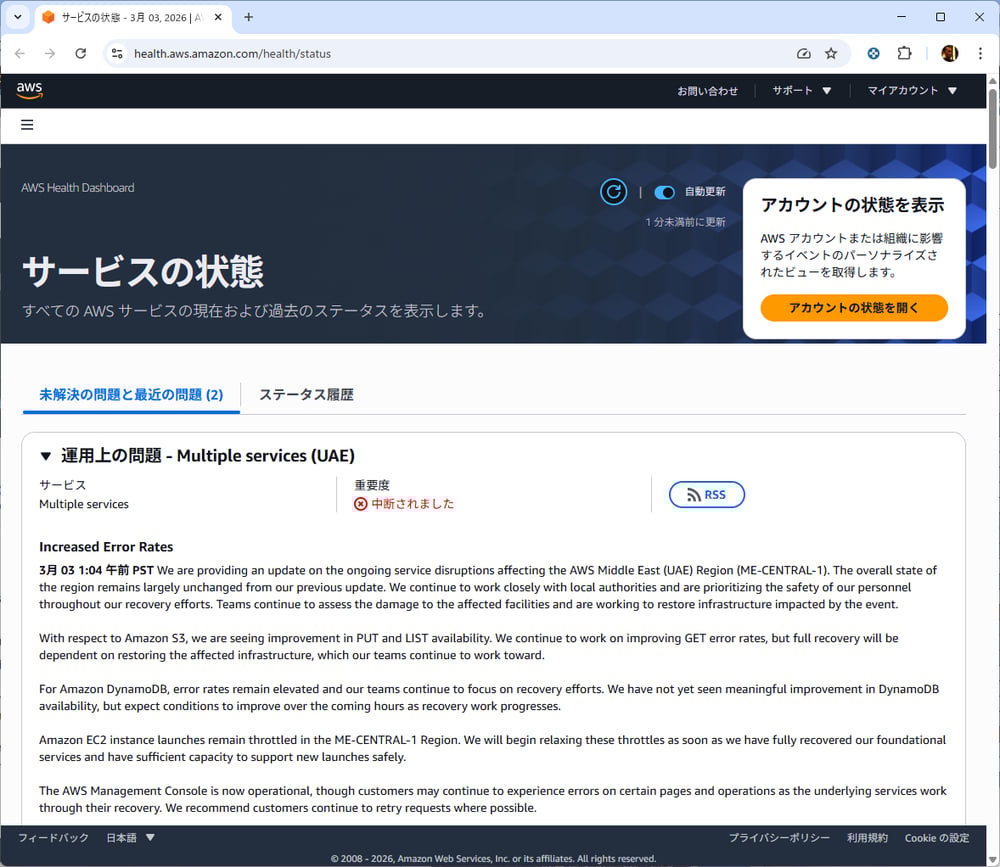 日本時間2026年3月3日18時過ぎの「AWS Health Dashboard」
